Tuesday, November 22, 2016

STOP THE VIOLENCE

Based from our social norms, violence is prohibited. Self-preservation is one of the reasons for the creation of our modern society and this makes violence prohibited. Based from our common perceptions, violence is inherently wrong and should be avoided.  With that in mind, I think the only people who will have a high probability of being directly affected by the glamorization of violence are the people who has a high tendency of being violent (i.e. those who were abused during their childhood, abused by a lover etc. ). 

I think, the subtle hints of influences by the media are more disturbing. The media usually portray a hyper-realistic image of reality that people cannot immediately delineate as wrong or right. The things that fall in this category is the portrayal of female beauty in films or the roles taken by different genders as portrayed by the media. We tend  to believe the life that the media shows us and considers it as reality. Intended or not, the media suggests subtle hints of different abuses and is tolerated by the general public.


Thus, although the media does not directly cause violence. The use of violence will eventually be considered by people who are affected by the subtleties in power relations in gender or race that the media tend to portray. For example, some men may think that women who wear skimpy clothing are “asking for it” because the media portrays women with skimpy clothing as women who are asking for it. Some women are abused because they look like they were asking for it.  Another example is the portrayal of “dumb blondes,” “playboy jocks,” and “latina maids” which affects the mindset of people that sometimes may lead to violence.  

Cooking and Masculinity in Sweden

http://m.phys.org/news/2016-11-cooking-masculinity-sweden.html

Gender biases and stereotypes in children's toys


Gender biases and stereotypes in children’s toys

I have a challenge for you all: whenever you have the free time to visit a local toy store (Toys R Us, Walmart, Target, etc.), walk over to the toy section and see if you spot any gender biases/stereotypes in their toys. Most often than not, you will notice a major difference between “boys” and “girls” toys. An assignment that I had to do for one of my classes was write a paper explaining if there were any gender biases for the toys at a local toy store. I will just briefly explain my experience during my visit:

I decided to go to the Babies R Us on Alafaya Trail. I walked over to the “pink” section first. Everything in the “Dolls” aisle was literally wrapped in bright pink packaging. From Barbie Dolls to Hello Kitty, the entire section was engulfed in pink. The only section in the girls’ aisle that was not bright pink was the Frozen section. This area was periwinkle. The selections of toys for girls were narrowed down to vampire, fairy and Barbie dolls, stuffed cats, ponies and unicorns, and pretend house items. The fake baby dolls were all in one section, however. There were also strollers and baby clothes provided for them. The box on these dolls said, “Perfect for Caring and Nurturing”. I also noticed that the dolls were predominantly white. There was only one baby doll that was of a darker skin tone. The last section was the “Pretend Play”. This section had pretend kitchen sets, pretend cookware, pretend iron with an ironing board, and pretend vacuum cleaners. Young, white girls were depicted on most these toys and the other toys in the “pink” section.

Next, I went to the boys’ section. This section was mostly dark blue, however there were other areas colored yellow and red. “Trucks & Cars” was exactly that: Hot Wheels, toy trucks, and a Star Wars spacecraft. The “Action Figures” were extremely fit and defined. I also noted that I did not see any action figures with a darker skin tone. There were either white or Hispanic, young boys depicted on these on the boxes. The bikes were also gendered. The girls’ bikes were pink and had frilly ribbons on the handlebars. They were significantly smaller than the boys’ bike. The boys’ bikes looked more durable and appeared more reliable.

This experience showed me how toy companies feed into the social construct of gender and how heavily of an influence they have on young children. I also learned that parents are more likely to give children a requested “gender-typical” toy than a requested cross-gender toy because this is how they want their children to be identified based on their biological sex. They want their children to behave a certain way based on their gender. Girls become aware that they are able to play with masculine items and not be penalized for it. Boys were always told not to play with feminine toys, so their preferences will most likely remain the same as they get older. By doing this, the kind of message parents are sending to their children is that their children should only be happy playing with toys for their gender and that if they played with cross-gendered toys they will not be “normal” and will be punished.

Representation is everything and heavily influences how a child perceives themselves. If a kid sees a child on a box that looks like them (i.e. same gender, race, age), then they are more likely to want that toy and believe that they are only allowed to play with that toy. Toy companies are very good at marketing to children this way. By being taught that girls and boys can only play with their gender-specified toys at a young age, this greatly influences how they choose to express the gender when they are older. The images and labeling of toys has a great influence to children’s gender identities.

Gender Roles & A Star Wars Backpack : A Personal Story


The first remembered occurrence of running into society's gender norms was in pre-kindergarten. I was different from all of my classmates and this frightened me as a child. When all the other girls in my class were wearing backpacks with princesses or Barbie on them, I felt secluded. I was the only girl in class with a Star Wars backpack along with my R2D2 lunch bag. I began to question whether or not I was a boy. I remember coming home to my parents on the first day of school and crying because I thought I was a boy and my evidence to prove it was that I had a deeper voice and I loved "boyish" things. Star Wars was something I loved and grew up watching, I never knew it was meant for inherently male audiences at the time. All I knew was that I loved it and I wanted to showcase my love for it in school. Playing the role of a female seemed challenging to me. I asked my parents if I could love these things and still be considered a girl. They laughed and laughed but eventually said yes. They said I can be anything I want to be and whoever I wanted to be. If I wanted to like princesses and barbies, that's fine. If I wanted to like robots and light sabers, that was fine too. I grew up learning to accept my more masculine traits while also embracing my inner femininity. Today, I can firmly say that we are who we are and we love  what we love. To change in order to fit society's standards is simply to give up on who we are. I will never give up on fighting for mine and others' rights to fully express who we are without social repercussion. I hope that, even now, there's a little girl at school who is just like how I was with a Star Wars backpack. Except now she will be accepted for liking the franchise with a female character named Rey as the head. I hope that the little girl grows up to be whoever she wants to be without the obstacles from others that I faced in my past growing up.

Gay Men in Black Fraternities


Gay Men in Black Fraternities

I was hesitant to write about this particular topic because I know Greek life can be an extremely touchy subject. I am not a member of any of the organizations in the National Pan-Hellenic Council, but I am very supportive of these organizations due to their historical background. NPHC represents the nine historically Black fraternity and sororities (Alpha Phi Alpha Fraternity, Alpha Kappa Alpha Sorority, Kappa Alpha Psi Fraternity, Omega Psi Phi Fraternity, Delta Sigma Theta Sorority, Phi Beta Sigma Fraternity, Zeta Phi Beta Sorority, Iota Phi Theta Fraternity). They are also referred to as “The Divine 9”.

Specifically, this post is in regards to gay men in Black Fraternities. I found an article from the Huffington Post titled Gay Men in Black Fraternities by Gregory S. Parks. In the beginning of the article, Parks mentions the controversial incident that sparked national news. Two gay Black men, Nathaneal Gay and Robert Brown, married in Lexington, Kentucky. Gay had a fraternal affiliation: Kappa Alpha Psi. Gay and Brown’s wedding was cream and crimson themed. Gay invited his pledge brothers to the wedding where they all took a picture holding up the fraternal hand sign. The wedding brought unwanted national attention to the fact that some Black fraternity members are gay and may be inclined to marry other men.

Gay believed the video was spread from a rival organization. He did not intend for his wedding to solely represent Kappa Alpha Psi. In my opinion, I do not believe Gay should have had to explain himself to the public. His wedding should not have sparked national attention. This also makes me wonder why there is not enough awareness of gay men in Black fraternities. According to Parks (2012), there have only been two groups of scholars to research issues around gay men in black fraternities. Dr. Alan DeSantis and Marcus Coleman (Kappa) studied the attitudes of members of four black fraternities about gay members, and Dr. Rashawn Ray and Kevin Spragling (both Alphas) studied the experiences of gay Alphas. They both found that homosexuality is rarely ever openly discussed in Black fraternities and is only engaged in order to condemn it.

I believe notions of masculinity heavily influence Black fraternity members’ attitude towards gay members. There are well-defined stereotypes of each of the NPHC fraternities. Omega Psi Phi members are stereotyped as the man’s man, masculine, bad boys, anti-intellectual and ideal lovers. Kappas are stereotyped as ladies’ men, bad boys, “pretty” boys”, and, interestingly, effeminate. Alphas are stereotyped as gentlemen, nice guys, intellectuals and the ideal date and husband. From what I’ve witnessed, members of each of the fraternities love playing up to their stereotypes. I do not have any experience in these organizations, but it makes me question if homosexuality may lead to gay pledges being treated worse or harsher than those who are not. This may or may not be the case, however the discussion on heterosexuality, homosexuality, and masculinity is long overdue in the Black community – and especially in fraternities.

Masculine Traits in Disney Villains


After looking into the masculine themes that Disney shows in its films, I began to think of how much those traits are heavily used to create the Villains that we've come to know and lovingly despise. In the article below, Dana Gorzelaney-Mostak analyzed the music that has been associated at the Disney Villains' theme songs. The author points out the starking contrast between the quintessential feminine princesses and their villains, "The original Disney princesses (prior to the 2000s) are known for their child-like, helpless, and submissive nature, exemplifying a socially conventional ultra-feminine persona; the music that underscores the characters affirms these qualities... In the world of Walt Disney, as in any other fairy tale, the “happily ever after” each princess wishes to attain is threatened by a frightful villain... What we learn from their music, however, is not just that they are evil, but that they transgress gender." I found this to be incredibly interesting as the author learns that Villains Such as Ursula may be representative of stereotypes within our society. Ursula is seen as having masculine body traits but moves gracefully in a feminine way. Her low voice, exaggerated makeup, and short silvery hair are somewhat remiscnet of Drag, according to the author. Her song, "Poor Unfortunate Souls" is a combination of Percussion and Brass based instruments which have been known to be typically masculine. Not a single feminine instrument was used to make the song such as violins, flutes, or harps that are typically associated with the Disney princesses. Overall, this article was a wonderful read that really makes me examine some of the undercurrent themes that Disney placed within the movies that I grew up with. Maybe the things we learned about the villains from our childhood came from a society that was frightened of the unknown. I'm curious to see what future Disney villains will be like as society starts to accept gender fluidity. 


#Masculinitysofragile

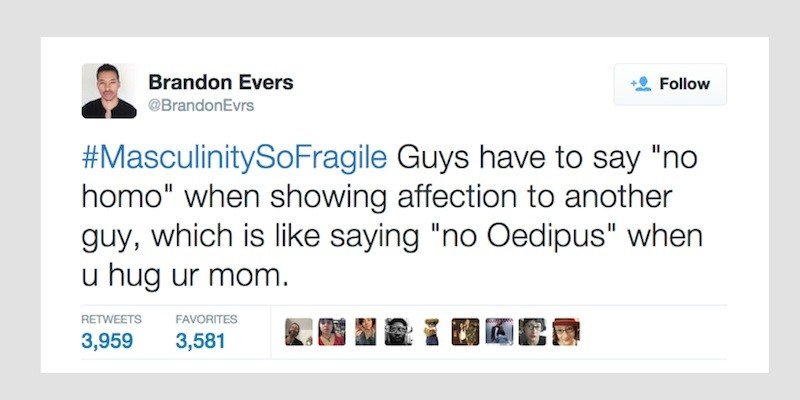
Insecurity is a key ingredient for the capitalist modern society to utilize gender roles. Throughout history, societal standards has set a rigid definition of gender roles and created a clear distinction between the masculinity and femininity. People who deviate from their gender roles are seen as abnormal or sick. The fear of not meeting the expectations of the society in a man or a woman resulted to an enormous insecurity. Both men and women are pressured to follow their gender ideals. As time passed, the society became more open about homosexuality and accepted that there are men who desires to blur the perceptions between the dichotomy of the two genders. The acceptance of the homosexual male resulted to an intense pressure for the straight males to prove their “straight-ness.” Now, please don’t misinterpret me. This phenomenon is not the fault of the expressive homosexual male because this intense pressure that I am talking about stems from a very old kind of insecurity which is the fear of the individual that “he” does not fit his gender ideals.

Honestly, throughout history we have been more strict in viewing what is masculine than what is feminine. Femininity focused more on the physique and appearance. In this case, we are talking about sexiness, boobs, hair, eyebrows, plus other desirable body parts. This is the reason why femininity suffers from transforming the women into a mere “sexual object” for “viewing pleasure.” Alessandra Ambrosio in a man’s shirt is hot; but Cristiano Ronaldo in a women’s tee? You know what I mean. Masculinity is quite different. Masculinity is a persona that encompasses the lifestyle, the hobbies, the actions, the things used etc. It’s a whole lifestyle package. This resulted to the fragility of masculinity. This fragility was only made worse by the capitalist when they utilized the already difficult position of men to gain some profit from it. They created the male persona--hmmmnn, what are the male personas of 2016? The fuckboy, the lumberjack, the bad boy etc. More and more companies utilized the insecurity of men. They used the fear of men to appear as not masculine to advertise grooming products, basic necessities, even food even though sometimes, they just use the same formulation for both men and women.

Masculinity, in its purest sense, is not fragile. It is an identity beyond what is seen and expected. Identity and mindset is a strong foundation because it comes from someone’s determination to prove his gender role regardless of his shampoo brand or his boxing routine during shower time.

To give you a better idea check out shampoo commercial! 


As an individual, I believe that masculinity is beyond our insecurity as social beings but, unfortunately, it is not easy to remove insecurity amongst individuals especially if everybody else got the same mindset. We have a long way to go but recognizing that truth that it’s not gay to use a sweet scented shampoo is a start. 

How The Ideal Man's Body Has Changed Over the Years

Here’s another video I came across on my Facebook timeline that I just had to share with the class. Has anyone ever seen those ’100 Years of Beauty’ videos where different women dress up or are made up to represent a different era of beauty in a given country or culture? This video is like that, but the topic here is men’s bodies in America over the years. Artist Nickolay Lamm compiled photos from the 1870s to see how popular male body trends have changed from then to now. Looking at the video, it is crazy to think about how our trends and attitudes toward beauty change over the years. For example, in the 1870s, we used to glorify big men because it meant they had more food than others, and thus more money. These days, most men try to get the “lean and muscular” look that is so popular in television and advertisements today. This is just a testament to how quickly fads fade and attitudes change. Click the link to see Tech Insider’s video on the topic:


Bullying Based on Sexuality

       Bullying has always been a problem, especially among youth. In today’s society, so much bullying is concentrated on sexual orientation and gender. The site provided below lists some very shocking statistics on the LGBTQ youth community and bullying. Young gay men are often bullied the most. To be gay is outside the masculine identity, and therefore labeled “abnormal”. Other young boys reinforce their own masculinity by bullying and emasculating those who different than themselves. I strongly believe there is nothing wrong with being gay, lesbian, transgender, or anything else. The statistics are sickening and most be put to a stop. When children no longer feel safe at school, society should take notice. 

Masculinity in Disney Films


This video does a wonderful job overviewing some of the common themes we've seen in the Disney movies we've come to love. Disney is known for being one of the big media franchises that either upholds or breaks stereotypes, depending on when it's fitting for them. You see common tropes such as the damsel in distress eventually break down  throughout the years, despite Disney being always seen as routine. Though Disney can be a a way of changing social norms, there are still many that they upheld. The video looks at the tropes Disney uses in terms of masculinity. Disney has shown overpowered, possessive, and sometimes violent male characters. The video overviews common themes such as the objectification of women, consistent strong physically-abled bodies, the persistence of inequality within Disney Movies. Overall, the video takes a close examiniation of the concepts we may not have understood in our childhood and makes us question how we feel about the display of those themes in current/future children movies. Looking ahead, as the norms of masculinity become more diverse,  Disney may start to accept and display different themes that are more appropriate and positive for future generations.

Female Masculinity?

I came across this YouTube video a couple weeks ago when I was scrolling through my Facebook newsfeed.  The video really shows how fluid gender can be and how the current labels we hold can be changed and how we identify ourselves is every-changing. The video includes people of all different idenitifications and clearly articulates how stereotypes and norms have changed. The video overviews Female Masculinity and what exactly it means. Particularly, "Female Masculinity is a considered to be a rebellion" of the performance of both genders. One participant in the interview said that female masculinity leaves out all the bad parts of masculinity but keeps all the good. The video also goes over some of the struggles the participants had to deal with when discovering who they are and what they needed to do to become who they are. Overall, it was a very inspirational video. The video is exemplary in showing that you can be who you want to be and that there is always a light in the distance, despite the dark times we experience.

Masculinity in STARZ's Power

Masculinity in Power

*Quick Disclaimer: This post contains spoilers!

For this blog post, I wanted to discuss the masculinities in one of the summer’s hottest T.V. shows STARZ’s original series Power, starring Omari Hardwick. This show was created by Courtney Kemp Agboh and produced by rapper Curtis Jackson (A.K.A 50 Cent). The show has a lot of plot twists so I will attempt to summarize it as best as I can. This show is about James "Ghost" St. Patrick, a wealthy New York night club owner who has it all, catering for the city's elite and dreaming big, lives a double life as a drug kingpin. He is constantly balancing his double lives in the hopes that they do not coincide with each other. His best friend is Tommy – he is pretty much his righthand-man in the drug business. They’ve been best friends since high school and consider each other brothers. However their brotherhood is tested when Tommy falls in love with James’ bartender, Holly. “Ghost’s” distributor, Lobos, informs Tommy that he needs to kill Ghost or else he will kill Holly. Holly ultimately gives Tommy an ultimatum: he chooses her or Ghost. In the meanwhile, James is balancing his relationship between his wife, Tasha, and his mistress, Angela. James and Angela had a past relationship in high school and rekindled their relationship when he saw her at one of her clubs. However, Angela works with the FBI and is investing the Lobos case, which James is involved with. While that is going on, Cannon (played by 50 Cent) was released from jail. He was sent their due to James. Cannon primary focus since his release is getting his vengeance on Ghost. He failed his first attempt to kill Ghost, however he managed to escape while the whole town thinks he’s dead.

Sexism Sucks for Everybody, Science Confirms

http://www.smithsonianmag.com/science-nature/sexism-sucks-everybody-science-confirms-180961178/

Young Men Are Facing a Masculinity Crisis

http://time.com/4339209/masculinity-crisis/

Monday, November 21, 2016

The Military: The Truth about Women, Suicide, and Sexual Assault.


The Military: The Truth about Women, Suicide, and Sexual Assault. 

The military. When most people hear this word they think of our soldiers, freedom, and war. But when I hear it, I think of sexism, sexual assault, and suicide. I am a soldier in the United States Army and I am a woman. I have served for the last 8 years and in my time I have been sexually assaulted, dealt directly with sexism, and have lost a few of my women battle buddies to suicide. While advocacy and support have helped create some change we still have a long way to go. Suicide rates are easier to track but sexism is from personal experiences and sexual assaults do not have clear data due to under or no reporting. 
 Image result for Women Army
On October 26, 2016, ten women became the first female graduates from the United States Army's Infantry Basic Officer Leader's Course at Fort Benning, Georgia. This was a long time coming and looks very promising for future female soldiers. Unfortunately the majority of male soldiers do not agree with this and it increases the chance for sexual assault. Many male soldiers feel superior to women soldiers and continue to feel the need to assert their dominance and express their violent behaviors. For 2015 the DOD reported that there was 6,083 reports of sexual assault for allegations involving service members. This is only the reported ones and many more do not due to what happens to many women and men when they do report. An example would be a Lieutenant Vorland who while in Iraq was sexually harassed by a high ranking male officer and filed a formal complaint as per the rules. In turn, the male officer was not reprimanded and the victim was discharged with a general discharge for "unacceptable conduct" and blamed her for the incident due to her acting inappropriately and agreeing to consensual sex (even though she was a lesbian) and by her having to reveal this it in turn got her kicked out due to the "don't ask, don't tell" still be enacted. 
Image result for Women Army Sexual Assault
Pictured above is LT. Vorland 

Researchers know veteran suicide rates are rising, but until recently, "studies haven’t factored in gender. Now, research has found that the rate of suicide among female veterans is nearly six times greater than it is among female civilians, a far greater disparity than is the case for their male counterparts" (Kaitlyn Landgraf 2016). We conduct sexual harassment, sexual assault and suicide prevention classes every quarter as a way to advocate and try to prevent these things from happening but from my experience, it does not help at all. I do not like talking about my sexual assault experience but I will say that he was an older, higher enlisted soldier who was about to retire and I was a young, E-1 private and female. I got myself out of the situation before it got worse but I was so shocked and disgusted and even was questioning what happened because I did not think it really happened that I did not say anything to anybody for 2 days. I came home and told my husband even though I did not want to even tell him. I called our acting commander (due to our unit and commander being deployed to Iraq at the time) and I let him know what happened. He said he would go up the ladder and let whomever know that needed to. I waited and waited to hear something and when I finally did, it was from another sergeant who should of never known what happened. I was told that I needed to stay away from him and to not go into rooms alone with him. They told him to stay away from me and not talk to me and if he needed to go into a room where I was to bring someone with him so that I could not say he did something wrong. He told them that I came onto him and that he felt uncomfortable so that is why he went along with it. They did not even make him apologize and I was forced to not come to work with no pay for 3 months because that is how long he had left until he retired. Even though it has been 7 years since this happened, it still bothers me to this day and ruined some of the trust I had for any of my male higher ups. These issues are real and serious and something needs to be done because the DOD is not doing enough. 
Image result for Women Army Sexual Assault

 Date Posted: 11/21/2016

http://time.com/4340321/sexual-assault-military-discharge-women/

http://www.defense.gov/News/News-Releases/News-Release-View/Article/752270/dod-releases-fy15-annual-report-on-sexual-assault-in-the-military

http://www.santacruzsentinel.com/article/NE/20160713/NEWS/160719887

Drake & Fragile Masculinity

Drake recently did a commercial promoting apple music through Taylor Swift's song "Bad Blood." In the commercial Drake is working out with his trainer, when his trainer leaves he turns on "Bad Blood" and ends up dropping the weights. The commercial ends with the phrase "distractingly good." There is one tweet that comments on the one minute commercial that is receiving a lot of backlash.


Many people on twitter are calling out the commentator's "fragile masculinity."


Check out the video here: 

What makes this individual's masculinity fragile is the fact that he believes Drake "took an L" for singing along and dancing to a Taylor Swift song. Taylor Swift's music is often times seen as music that appeals to young girls and women more than anyone else. The fact that Drake seems to be enjoying her music in this video threatens masculinity. To be masculine one must not seem too feminine. By enjoying Taylor Swift, Drake is deemed as not being manly enough. When someone's masculinity is threatened by the actions of others, they are seen to have a "fragile masculinity," since it can be jeopardized at any point. 

Nazi Punks F*#k Off

From almost day one in a man's life, they are pressured by oppressive, aggressive male presences. Things like "suck it up" "get over it" "boys don't cry" "be a man" are all thrown at them from a very early age, from external sources, as well as those they trust the most: Their own families. Most of the time, when family members perpetuate the myth that men aren't allowed to have deep emotions, or be wounded by emotional things, it's not out of malicious intent, its simply a learned behavior that they involuntarily perpetuate out of a desire to help their child fit in, or avoid being singled-out. Every day we as a society make efforts to overturn this impulse, and allow young boys to experience, process, and understand their emotions, to make them grow up into young men that will not be lost when it comes to the complexities of dealing with real life. To allow them to cope with their emotions, rather than bottle them up, and use external dampeners in order to remove those emotions from themselves.

That is not what we are here to talk about though.

The subject of home-grown influences leading young men down a path of violence and despair has been well documented, and well-tread by those seeking to help and heal. A not-often explored element of the toxic masculinity that the boys and men of our world face is the still pervasive presence of patriarchal superiority groups and causes such as the KKK and the Neo-Nazi Party. While obviously, these championers of hate and violence certainly all have roots in the childhood-taught patterns of toxic masculinity, (and the observance of the willful submission of gender-betraying females within these communities of hate), it is the cultural and societal endurance of these groups that form an essential, and highly dangerous step in the cycle of abuse that turns good men cruel.

The examples formed by these hate groups not only force a negative and destructive idea of what a man is supposed to do to be a "real" man, but also provides an example to these young men of what a woman is supposed to be, and if she won't be that way on her own, you're supposed to "teach her" how to be that way. Women being relegated to "feminine roles" in the household or in the community, such as being homemakers, not being allowed to have jobs or speak up for themselves, being forced to endure oppressive, or even violent behaviors, etc. These things all teach young men that to truly be considered a real man, you have to put others down, and assert your dominance over them.

Keeping those that are different from you "in their place" is the cornerstone of toxic masculinity, and it is NOT what being a real man is about. On the surface, strength, honor and courage are great ideals. Being a man is about having the strength to stand up for what is right, the honor to recognize what is wrong, and have the courage to act for or against these forces when needed. To protect those who can't protect themselves, and work hand-in-hand with those who would fight alongside you, no matter what race or gender they may be. For centuries these ideals have been perverted by those who have power, and keep it by providing warped versions of these core ideas to young men. Division allows oppressors to keep power, because while everyone is so busy fighting each other, they are not fighting those oppressing them. Women are the common string through all this. Men of all races have kept women oppressed, hiding behind a long-gone role as protector and provider during primitive caveman times, and as a result of this deep-seeded notion, they pass this perversion of manhood on to the next generation, willfully or not.

Masculine vs. Feminine

       Masculine and feminine traits are usually the complete opposite from each other. Here I have included a picture that labels certain traits to each gender. Masculine traits are the most sought after, although most people do tend to have characteristics from both “categories”. Females seek to embody a more powerful image, taking on masculine personality traits. Anyone who fits the feminine or female category is often labeled as a lesser person in society, weak. Socialization has taught us to believe this. Growing up, boys are taught that their characteristics are better, and females are taught to be “strong” and embody non-feminine traits in order to be successful in adulthood. I believe this is incredibly wrong. Child or adult, a person should behave and present themselves however they feel fit. There should be no good or bad qualities based on gender. Females should not be considered “weak” or “submissive”, just as men should not be considered “non-emotional” or “hard”. These kind of stereotypes reduce femininity to nearly nothing, while reinforcing masculinity and dominance.